Lesson 3: Prioritize Tasks
Contents
Prioritize Tasks
Now that we did a work audit (you did do the work audit, right?)....
Remember the funnel analogy?
We want to apply a prioritization framework to all of your incoming work. A popular way to do this is using an Eisenhower matrix (see below):
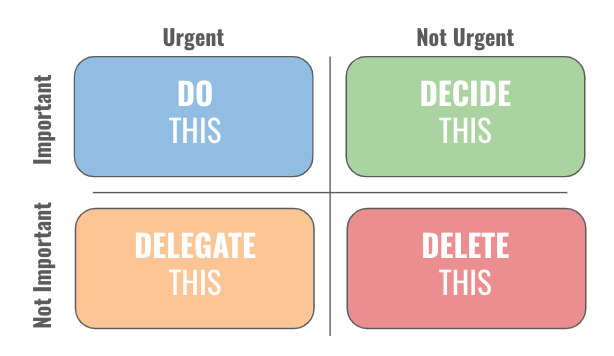
The Eisenhower Matrix is a productivity tool designed to help prioritize tasks based on urgency and importance.
The idea is to classify your work in one of the above quadrants in order to be crystal-clear on the things you need to focus on.
Here's how you handle each quadrant:
1. Urgent and Important (Do)
These tasks need immediate attention because they have pressing deadlines or significant consequences if not addressed quickly.
Examples: Project deadlines, emergencies, urgent client requests.
Action: Do these tasks right away.
2. Important but Not Urgent (Decide or Schedule)
These are tasks that contribute to long-term goals or personal growth but don't need immediate action. You will decide whether to do them or schedule them.
Examples: Strategic planning, personal development, relationship building.
Action: Schedule these tasks for a future time when you can focus on them.
3. Urgent but Not Important (Delegate)
These tasks need to be done soon but do not directly contribute to your main objectives or long-term goals.
Examples: Interruptions, some meetings, or routine tasks.
Action: Delegate these tasks to others if possible, or automate them if you can.
4. Not Urgent and Not Important (Delete)
These are distractions or activities that add no value to your productivity or goals.
Examples: Excessive social media, unproductive meetings.
Action: Minimize or eliminate these tasks altogether.
Avoid spending too much time on urgent but less important tasks at the expense of important but less urgent ones.
If you apply this methodology often enough, you will start to adopt the mentality of first asking yourself:
"Is this a problem we should be working on?"
Our goal in prioritization is to ask ourselves this question before we take on work.