Lesson 6: Team Effectiveness
Contents
Video
Team Effectiveness
Building a team that consistently delivers requires more than hiring good people. It requires the right structure, the right culture, and the right operating rhythm. This lesson covers the frameworks that help you think about team effectiveness at a systems level.
Conway's Law
Conway's Law states that organizations tend to produce systems that mirror their communication structures. In other words, how your team is structured determines what they build and how they build it. This is particularly relevant in technology organizations, but it applies broadly.
The practical implication for leaders: before you try to change what a team produces, look at how the team is organized and how it communicates. Often the output is a symptom of the structure. Fix the structure, and the output changes.
The Three Levels of Team Work
A useful way to think about what a team does is through three layers, from the ground up.
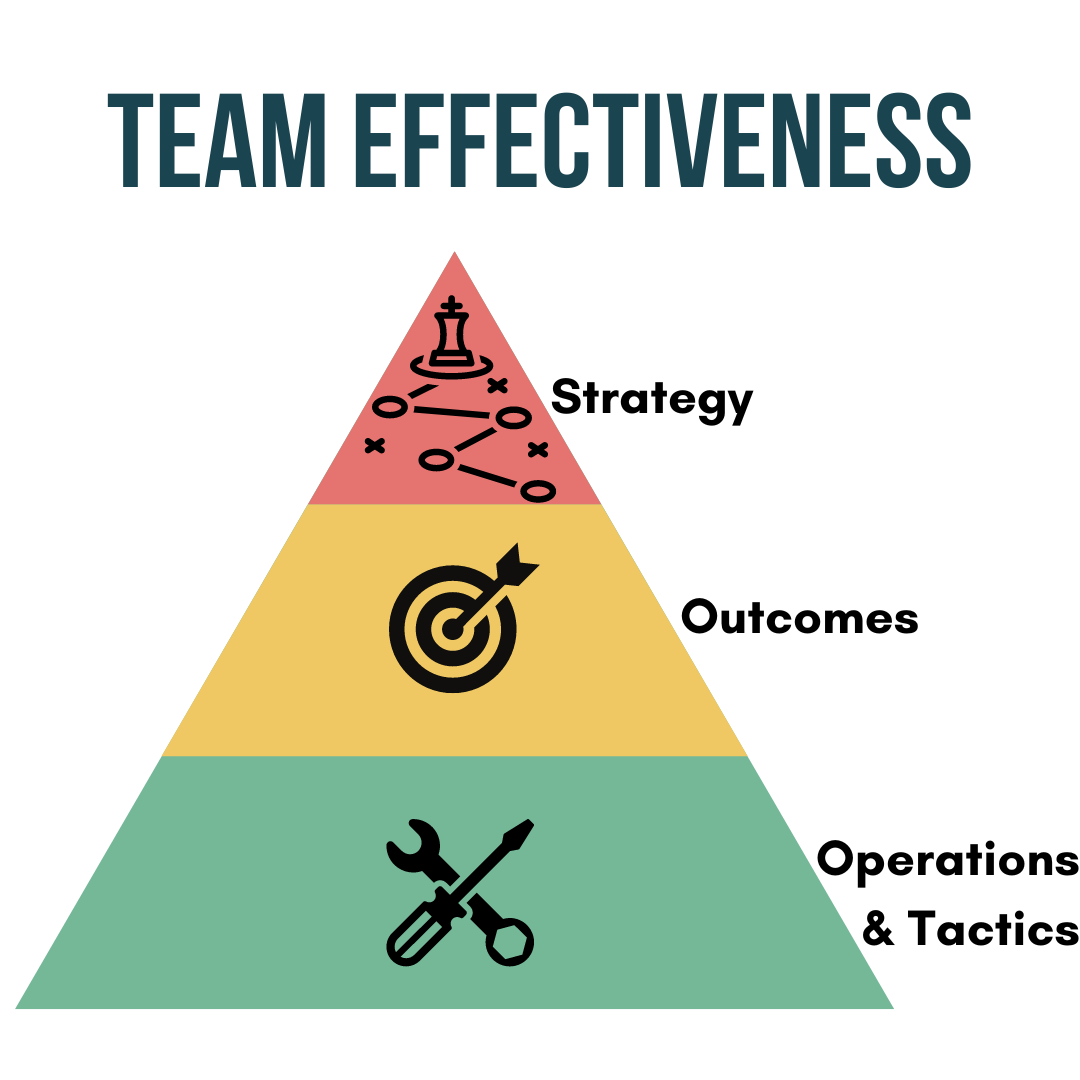
Use this model as a quick diagnostic. If you are failing to deliver, the problem is often that the team is stuck in the bottom layer and never creates enough space to operate in the middle and top layers.
- Operations: The day-to-day execution work. Keeping the lights on, handling requests, running existing processes. Every team has this layer, and it needs to run reliably.
- Outcomes: The results the team is accountable for delivering. Objectives, goals, measurable improvements. This is the layer where teams create value - not just activity.
- Strategy: The longer-horizon thinking about where the team is going and why. How does this team's work connect to the organization's direction? What investments need to happen now to enable success in the future?
A common failure mode is teams that live entirely in Operations - always reactive, never strategic. The leader's job is to carve out space for Outcomes and Strategy work, even when Operations pressure makes that feel impossible.
The Red/Green System
One practical tool for maintaining visibility into team health and work status is a simple Red/Green framework. At any point in time, every significant workstream on your team is either:
- Green: On track. No intervention needed. Continue monitoring.
- Red: Off track or at risk. Needs active attention, intervention, or escalation.
The goal is not to have everything green all the time - that is unrealistic and often a sign that people are not being honest. The goal is to have accurate visibility so that when something goes red, you know about it early and can act.
Build the habit of asking your team for Red/Green status on key initiatives in your regular check-ins. Over time, this normalizes transparency and reduces the likelihood of surprises.
Focusing on Outcomes
One of the most important habits a leader can build is relentlessly distinguishing between activity and achievement. Teams can be very busy - lots of meetings, lots of work in progress, lots of energy - and still not be making meaningful progress.
Set outcome-based goals where possible. Not "work on the customer portal" but "reduce customer portal load time by 30%." Not "improve the process" but "reduce the error rate from 5% to 2% by end of quarter." Outcomes give people something to orient toward - and they make it clear when the work is actually done.