Lesson 2: Organizational Structure
Contents
Video
Organizational Structure
It's important to understand how leadership and organizations are structured.
The diagram below illustrates it at the simplest level. This is often called "The Management Pyramid."
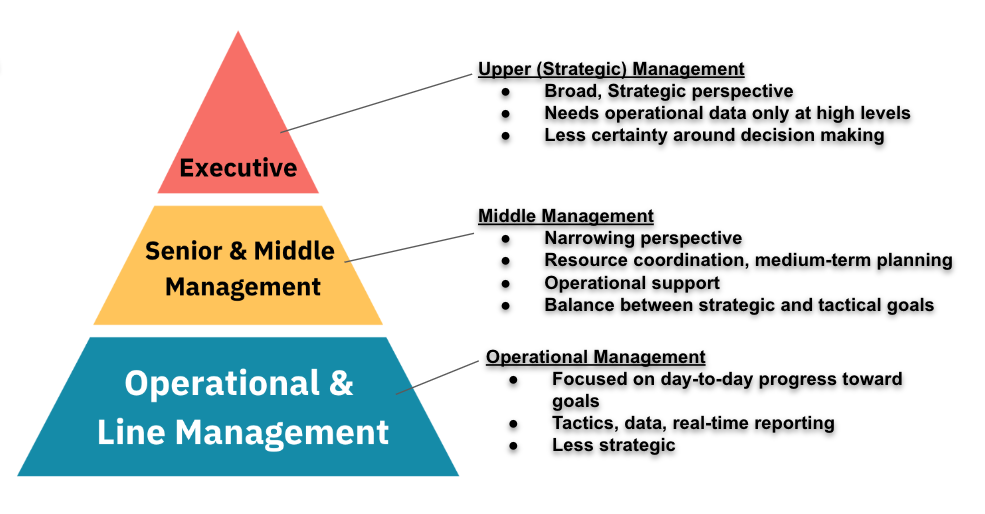
The top of any organization is the executive level. Executives are setting high level direction for the organization below, setting policy, and so forth.
The middle layer (normally director and VP titles) are balancing between strategic and tactical objectives, turning high level goals into actionable plans.
The lower level, operation and line management, is where the tactical work happens.
You should especially note that the pyramid is smaller at the top - there are far fewer executive roles out there. As you move up in your role and title, there are less people, and the competition is significantly greater - and more capable - than at lower levels.
What does this mean for you? Here is a positive way to interpret it:
There are a lot of places where you can apply your skills.
As you move up the pyramid, the skills that once served you on the operational level will not be sufficient.
Read that again, because it's really important: your technical skills are much less important, and your people skills (often called "soft skills") like connecting, networking, building alliances, and so on become significantly more important the higher up you go.