Your smartest technical people shouldn't lose the room.
Technical leaders rarely struggle because they don't know enough. They struggle because they know too much.
HEARD is a 90-minute working session that helps engineers, architects, and technical leaders turn complex thinking into clear, decision-oriented executive communication.
Bring something important you're struggling to communicate. Leave with it rebuilt for the audience that actually needs to hear it.
Bring HEARD to Your Team90 minutes · 6-15 participants · Remote or in-person · Real work, not role play
Someone asks one of your engineers:
"Can we ship this Friday?"
They know it's complicated.
There are dependencies. Risks. Edge cases. Something QA found yesterday.
So they start explaining.
Four minutes later, you're still waiting for the answer.
You didn't ask for the architecture.
You asked if they can ship Friday.
Answer first. Explain second.
Same expertise.
Completely different communication.
Now multiply that across your organization.
Status updates. Roadmaps. Funding requests. Architecture recommendations. Executive presentations. Customer conversations.
Your technical people usually know the answer.
HEARD helps them make the answer land.
The problem isn't expertise. It's translation.
Your technical leaders may be giving accurate, thoughtful, well-reasoned explanations.
But the person across the table is listening for something completely different.
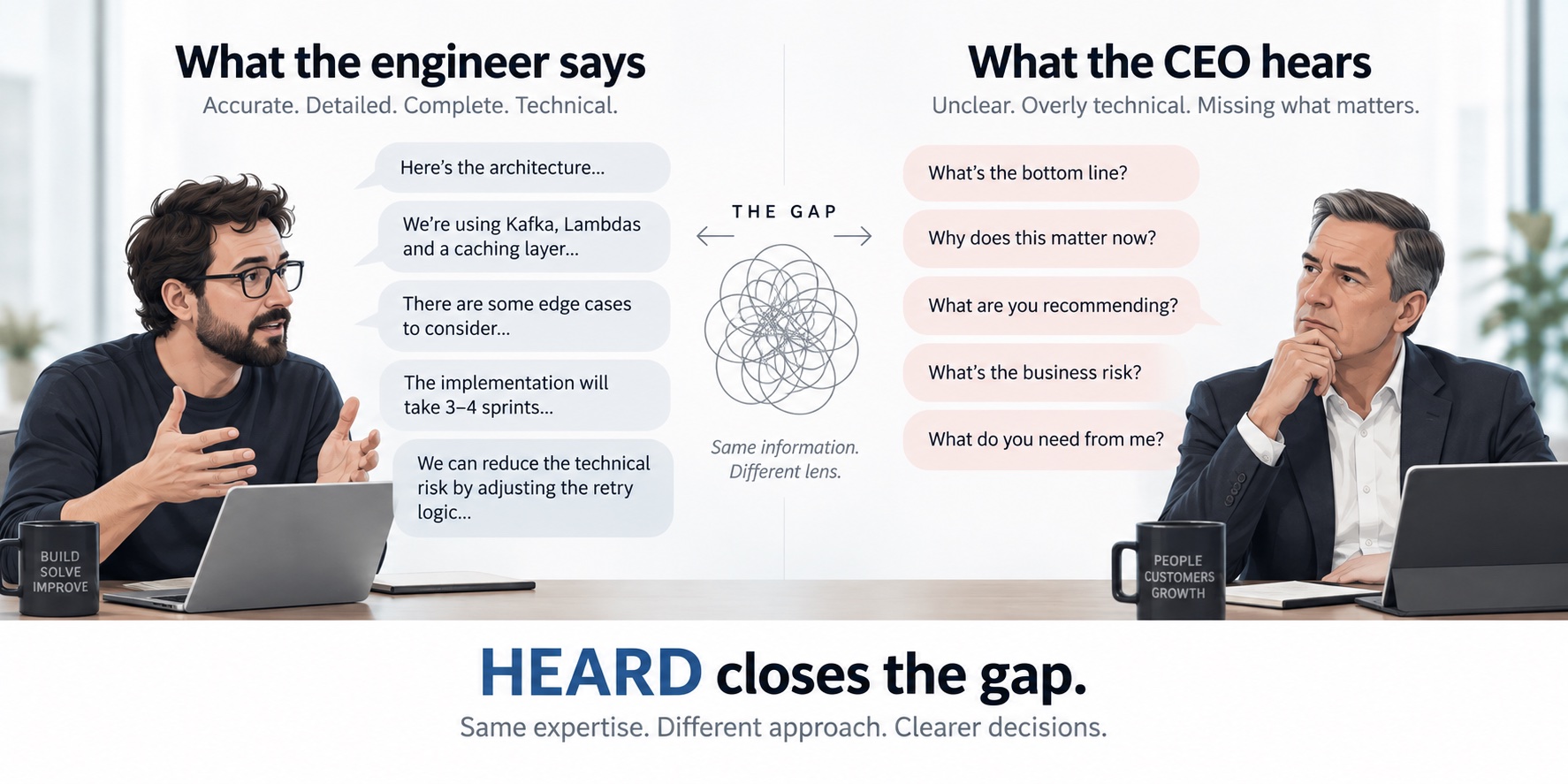
What the engineer says
Accurate. Detailed. Complete. Technical.
- "Here's the architecture..."
- "We're using Kafka, Lambdas and a caching layer..."
- "There are some edge cases to consider..."
- "The implementation will take 3-4 sprints..."
- "We can reduce the technical risk by adjusting the retry logic..."
↓ The gap ↓
What the CEO hears
Unclear. Overly technical. Missing what matters.
- "What's the bottom line?"
- "Why does this matter now?"
- "What are you recommending?"
- "What's the business risk?"
- "What do you need from me?"
HEARD closes the gap.
Same expertise. Different lens.
The engineer is often asking: "Do you understand how this works?"
The executive is often asking: "What does this mean, why does it matter, and what do you need from me?"
HEARD teaches technical leaders to close that gap - without stripping away the technical rigor behind the answer.
The problem isn't always how you say it.
Sometimes you haven't finished the thinking.
Technical leaders are trained to understand systems, evaluate tradeoffs, solve difficult problems, and get the details right.
Executive communication requires another layer of thinking.
Before you enter the room:
- Where's the ask?
- What's the total investment?
- What's the return?
- What's the business impact?
- What happens if we do nothing?
- What's your recommendation?
- What decision do you need from the room?
Don't bury the ask
If you're asking for $1.4 million, don't make the CEO discover that on slide 23.
Lead with the decision you need. Then earn it.
Don't make the CEO do the math
$275K here. Three engineers there. $84K in licensing. $110K in migration. If the CEO is reaching for a calculator, you weren't ready.
Roll it up. Know the number.
An ask isn't a business case
"I need three more engineers" explains what you want. A business case explains what they cost, what the company gets in return, what happens without them, and how you propose to fund the investment.
Proving you need something isn't the same as proving it's a good business decision.
Have a recommendation
Executives aren't paying you to present three equally weighted options and wish them luck. Explain the tradeoffs.
Then tell them: "I recommend B. Here's why."
Answer the question first
"Can we ship Friday?" The executive usually doesn't need four minutes of dependencies before hearing the answer.
"No. Tuesday is realistic. There are two reasons why." Detail can follow.
Technical expertise gets you into the room.
Executive thinking helps your ideas survive it.
HEARD gives technical leaders a repeatable way to think about the audience, the outcome, the message, and the ask - before they communicate.
Technical people communicate inside-out.
They start with what they know, build the context, walk through the details, and eventually arrive at the point. Executives listen the other way: What matters? Why does it matter? What do you recommend? What do you need from me?
Inside-out
How technical people naturally communicate.
- What I know
- What I want to explain
- How I'll explain it
- Hopefully they understand
Audience-first
How HEARD teaches them to communicate.
- Who am I talking to?
- What do they need?
- What outcome am I seeking?
- What do they therefore need to hear?
The point isn't to make your technical people less technical. It's to make their expertise land with the people making decisions.
Ninety minutes. Real work.
HEARD isn't a lecture with slides. Every participant brings a communication they actually own and works on it during the session.
Diagnose
See why technically correct communication can still lose an audience. The failure is structural, not personal.
Learn
The HEARD framework and the thinking behind audience-first communication. Compact enough to use the same day.
Watch
A real technical communication gets torn down and rebuilt in front of the room.
Apply
Every participant works on a communication they actually own: a presentation, proposal, recommendation, executive update, funding request, or roadmap.
Test
Deliver the revised version and find out whether the intended message actually lands.
Leave with it better.
Let's be honest about 90 minutes.
Nobody becomes a master communicator in an hour and a half. Anyone who promises that is selling theater.
- See what's getting in the way
- Learn a better mental model
- Apply it immediately
- Improve something real
- Leave with a repeatable method
The HEARD framework
Five moves that put the audience first. The framework serves the mental model, not the other way around.
Headline it.
Give them the answer first.
Don't make people search for your point.
Edit it.
Your audience doesn't need everything you know.
Decide what matters. Cut what doesn't.
Anchor it.
Give the idea something people can hold onto.
An example. A comparison. A number. A short story. Make the complicated thing understandable.
Real, not abstract.
Trade abstractions for specifics.
Don't say: "Engagement declined significantly."
Say: "Four out of ten users never came back."
Specific beats abstract.
Deliver it.
Put the message together and use it.
Not on a fake exercise. On something you actually need to communicate.
What your team leaves with
Deliverables, not just inspiration.
Something real, improved
A presentation, proposal, recommendation, executive update, or other important communication they brought into the session and rebuilt while they were in it.
A repeatable mental model
Five questions before any important communication:
- Who am I talking to?
- What do I want to happen?
- What's the answer?
- Why should they care?
- What am I asking them to do?
The HEARD Field Guide
A concise practical reference for executive conversations, presentations, proposals, and important written communication. Not a giant workbook. Built to be used Monday morning.
Built for technical people whose work depends on decisions made by other people.
Senior engineers. Architects. Engineering managers. Technical product leaders. Directors. Emerging technology executives.
And any subject-matter expert who regularly needs executive support, decisions, funding, or alignment.
These aren't poor communicators. They're capable experts working in environments where complexity has to be translated for audiences who think differently.
The higher they go, the less they're paid simply for knowing the answer - and the more they're paid for helping other people understand it, believe it, and act on it.
Built by a practitioner, not a presentation trainer.
HEARD came out of decades spent building and leading technology organizations - engineer, Chief Architect, VP, CTO, and currently SVP of Technology. Work that lives at the intersection of technical complexity, business decisions, and executive leadership.
It exists because I kept watching the same pattern repeat - in my teams, in my peers, and in myself:
Deep expertise doesn't automatically produce clear communication. Sometimes it produces the opposite. HEARD is the system I built to fix that.
Founding Team Workshop
- 90-minute facilitated working session
- 6-15 participants
- Participant pre-work, so session time goes to the work
- The HEARD Field Guide for every participant
- Real-world communication exercises, not role play
- Remote or in-person
$1,500
Founding-team pricing
I'm working with a small number of early organizations to pressure-test and refine the experience. The price reflects that. No countdown timer. No manufactured scarcity.
Talk to Cory About HEARDA short conversation about your team, your audience, and whether HEARD fits.
Your team's expertise shouldn't disappear inside their explanations.
Headline it. Edit it. Anchor it. Make it real. Deliver it.
Get to the point. Make it matter.
Get HEARD.
Talk to Cory About HEARD